
We Are Accepting New Patients  -  Proactive, Personalised Dentistry  -  Implants & Mercury-Free Care in Edinburgh

Category: Biological & Mercury-Free Dentistry

safe amalgam removal (IAOMT protocol), whole-body health, working with your wider collaborator team. Mercurysafe dentist. Biological or Holistic dentistry

  • “I Searched All of Scotland for a Metal-Free Implant”

    “I Searched All of Scotland for a Metal-Free Implant”

    By Dr Neeraj Puri, BDS (Glasgow 1996) Integrated Dentalcare, Edinburgh Published October 2026 7-minute read

    Almost every patient who comes to me for a ceramic implant tells me a version of the same story. They knew what they wanted. They just couldn’t find anyone in Scotland who offered it.

    They come from the islands and the north of Scotland, from communities like Findhorn, and from Northumberland, Yorkshire, Huddersfield and even the south of England. Most found us through a Google search that finally landed, or, for some, through the IAOMT’s directory of biological dentists, where we were previously listed. Almost all say the same thing: “I wish I’d known about you sooner.”

    Why people go looking for a metal-free implant

    The patients I see are rarely looking for “an implant”. They’re looking for a dentist who thinks about the whole person, not just the gap.

    Many describe what they want as holistic or biological dentistry. They want to keep metals out of their body wherever possible. Some have had allergy testing, such as a MELISA test, which suggested a sensitivity to certain metals. Others have read about metal particles and byproducts and would rather not take that risk. Others are already working with a health practitioner and want their dental treatment to fit with that wider approach.

    Some patients have concerns about root-filled (“dead”) teeth and how they may affect their wider health, and choose to have them removed. When that tooth is replaced, they don’t want metal going into the jawbone in its place.

    Others worry about mixing metals. A conventional implant is rarely just titanium: the screw, the connecting part and the crown can each be a different alloy. Some patients are concerned that different metals bathed in saliva can create small electrical currents, a “battery effect”, and want to avoid that altogether.

    I don’t think anyone should have to justify that choice. My job is to explain the options honestly, so you can make the decision that sits right with you.

    What they want is someone with real experience who understands why this matters to them, not someone who dismisses it.

    Why it’s so hard to find

    There are two reasons.

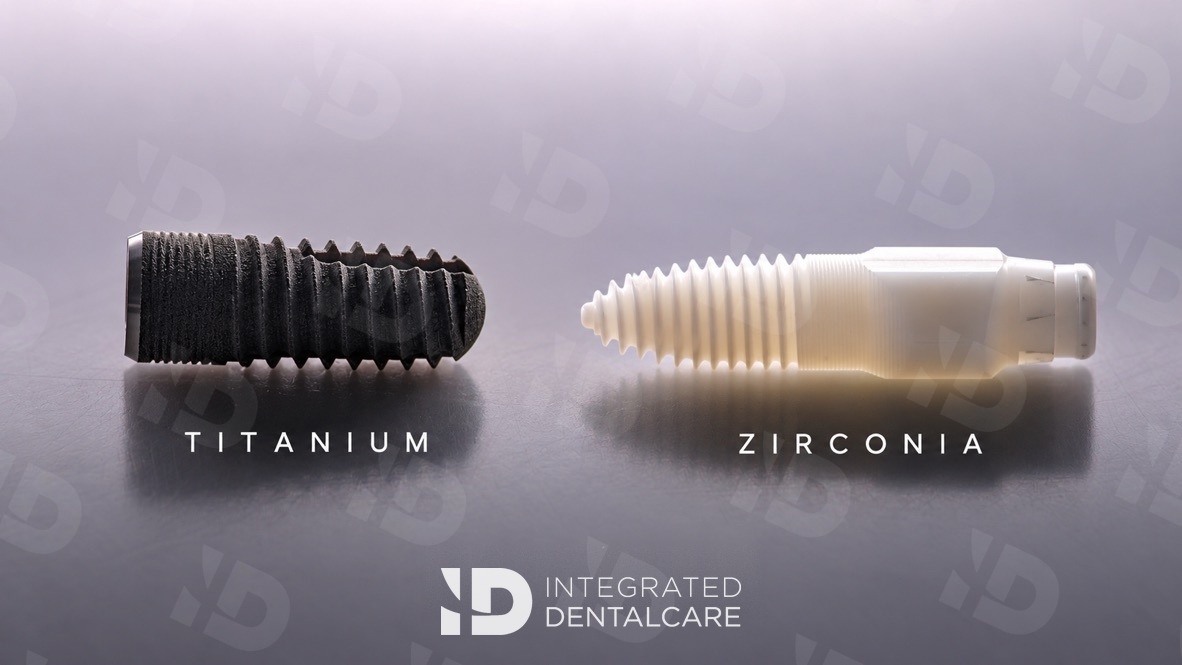
    First, very few dentists in Scotland place ceramic implants. They need different planning, different surgical handling and different components from titanium. Many practices simply don’t offer them.

    Second, even where the treatment exists, it’s hard to find online. Search for ceramic or zirconia implants in Edinburgh and you’ll mostly see directories and London clinics. Our own website hasn’t said enough about it either. That’s changing, starting here.

    What we do at Integrated Dentalcare
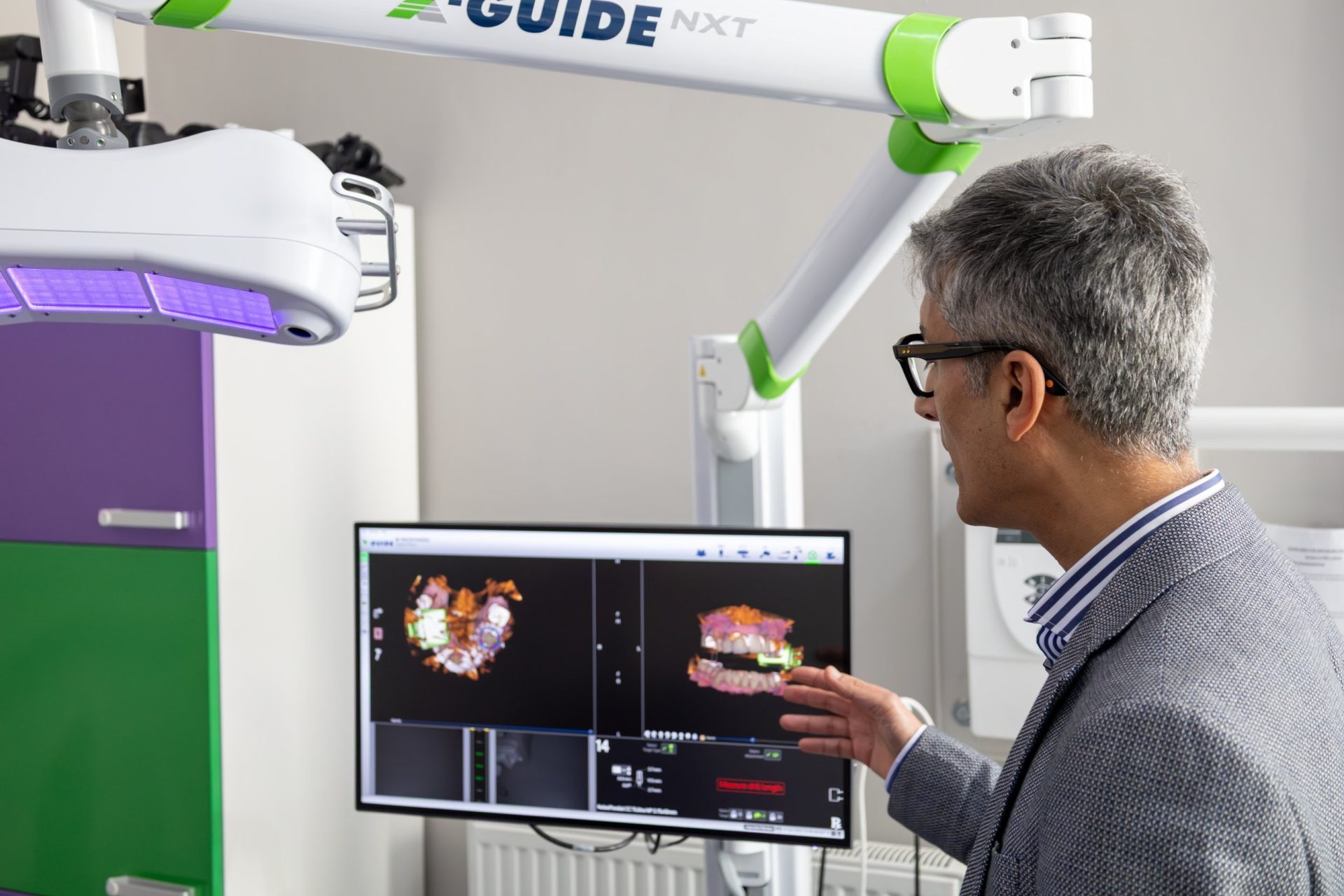
    Dr Neeraj Puri reviewing a 3D digital implant plan on the X-Guide NXT navigation screen at Integrated Dentalcare, Edinburgh

    I’ve placed implants for around 20 years and have been placing zirconia implants since 2010. Implant dentistry is the focus of my clinical work. My main ceramic implant system is Swiss Dental Solutions (SDS), and I also use Straumann’s ceramic implant where it suits the case.

    Most of the ceramic implants I place are one-piece designs. The implant and the part that holds the crown are a single piece of zirconia, so there is no internal screw and no join between different materials.

    A few things patients tell me matter to them:

    • Metal-free from root to crown. A zirconia implant with a ceramic crown, with no metal in the mouth.
    • Clean components. The SDS ceramic implants carry the CleanImplant Foundation‘s Trusted Quality mark. To earn it, randomly sampled sterile-packed implants are examined under a scanning electron microscope in accredited laboratories, then peer reviewed. The Foundation has found contaminants on many implants straight out of the packet, so few systems qualify.
    • Metal-free from start to finish. The SDS concept uses only metal-free products during treatment, even the surgical drills are ceramic. That isn’t the case with every ceramic implant provider.
    • Keyhole, guided surgery. I plan with 3D scans and place implants using X-Guide navigation, often through a small opening rather than cutting back the gum. Navigation is included in the fee.
    • Natural healing support. We use PRF, made from your own blood, and laser therapy to support comfortable healing.
    • The whole mouth, not just the gap. As an experienced general dentist, I look at old fillings, root-filled teeth, gums and bite before planning the implant. Many of our patients also ask about safe amalgam removal.

    Fewer visits: tooth out and implant in, often the same day

    Many clinics remove a tooth, wait months for healing, then bring you back to place the implant. That means more procedures, more injections, more healing time and, if you live far away, more journeys.

    In most of our cases, I remove the tooth and place the implant in the same appointment:

    1. Planned in advance. I plan the implant digitally before you arrive, choosing the position where it will carry biting forces best.
    2. The site is cleaned with laser. Laser decontaminates the socket, and the light also supports the body’s own healing response.
    3. Your own healing factors. PRF, made from a small sample of your blood, is placed in the site to support natural healing.
    4. Guided placement. X-Guide navigation follows my plan to the exact coordinates through a small keyhole opening. Unlike a fixed surgical guide, it lets me adjust in real time if the bone is softer or shaped differently from what the scan showed, which is often only clear once the tooth is out.

    The result is one procedure instead of several, a single healing period, and your new tooth sooner. Some cases need other problems resolved first, and I’ll tell you at your consultation if that applies to you. Navigation is included in our fees, so you’re not paying extra for it.

    A real X-Guide navigated procedure at Integrated Dentalcare, in under a minute.
    See the whole process for yourself, from 3D scans and digital planning to guided placement.

    One patient’s experience

    Eilean Donan Castle near Skye in the Scottish Highlands, with snow-capped mountains and its stone bridge reflected in the loch

    A functional medicine practitioner travelled six hours from the very north of Scotland for a ceramic implant. She had spent a long time looking for someone in Scotland who could offer it.

    Afterwards, she told us she was so glad to have found us. The procedure was minimally invasive and comfortable, and her healing went smoothly. She particularly valued the natural approaches to healing, such as PRF and laser therapy, alongside the guided keyhole technique.

    Is a ceramic implant right for you?

    Not always, and I’ll tell you if it isn’t.

    Where ceramic implants shine is wherever each tooth can be replaced as an individual implant. That might be a single tooth, a short bridge across three teeth, or even six or seven teeth, as long as each can be restored on its own implant to look like a natural tooth emerging from the gum. Because the implant is white, there’s no grey metal showing through thin gum, and even if the gum recedes a little over the years, it won’t look unsightly. Research also suggests gum tissue tends to respond well to zirconia, with some studies finding less plaque build-up than around titanium (Shrivastava et al., 2024).
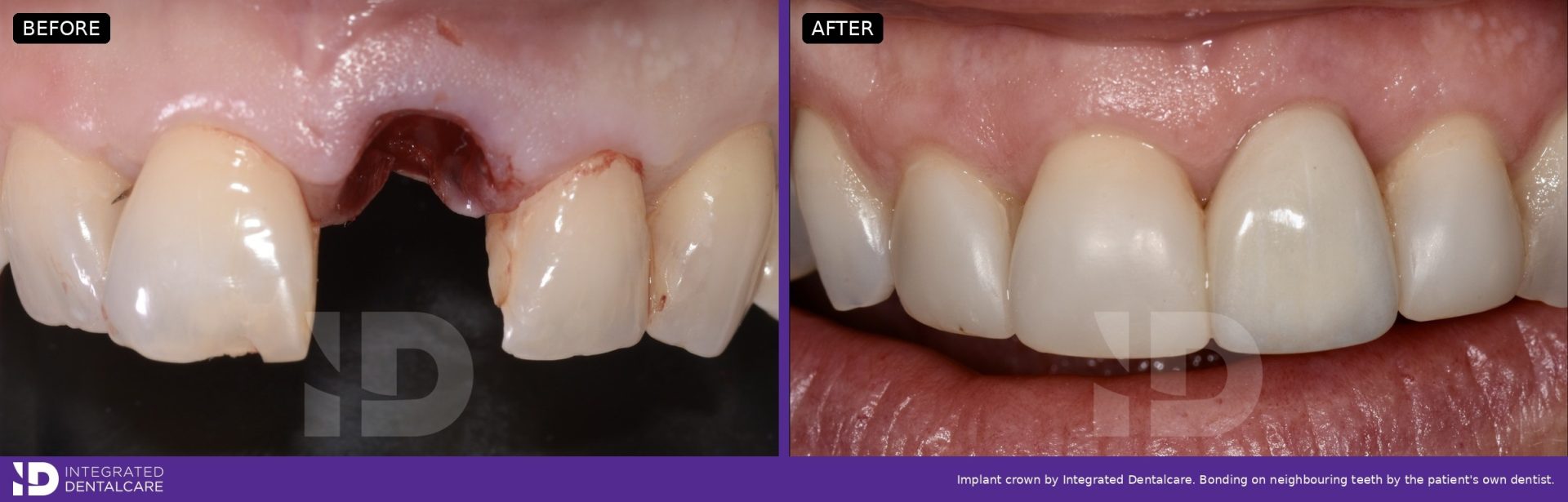
    Before and after: upper front tooth removed and replaced the same day with a Straumann ceramic implant, shown with the final crown four months later, Integrated Dentalcare, Edinburgh

    A front tooth removed and replaced with a ceramic implant in the same appointment, shown with the final crown four months later. Bonding on the neighbouring teeth was carried out by the patient’s own dentist.

    Where I’d usually recommend titanium:

    • Full-arch cases with a lot of bone loss. For a full mouth of fixed teeth where much of the bone has gone, these are often “end of the road” cases. Titanium systems give more flexibility, and the parts can be retrieved and adjusted if needed, which matters when you need the result to last for decades.
    • Heavy grinders and clenchers. Any implant can fracture under heavy forces, titanium included. The difference is retrievability: titanium systems are made of separate parts that can be adjusted or replaced, which gives more options if something goes wrong. If you grind heavily, especially under stress, titanium may be the safer choice.

    The exception is when only a few teeth are missing. Your remaining natural teeth help protect the implant, because they sense biting pressure and guide your bite. In those cases ceramic can still be an excellent option, even if you grind.

    The only way to know is a proper assessment. You can read more about the treatment on our zirconia dental implants page.

    If you’ve been searching too
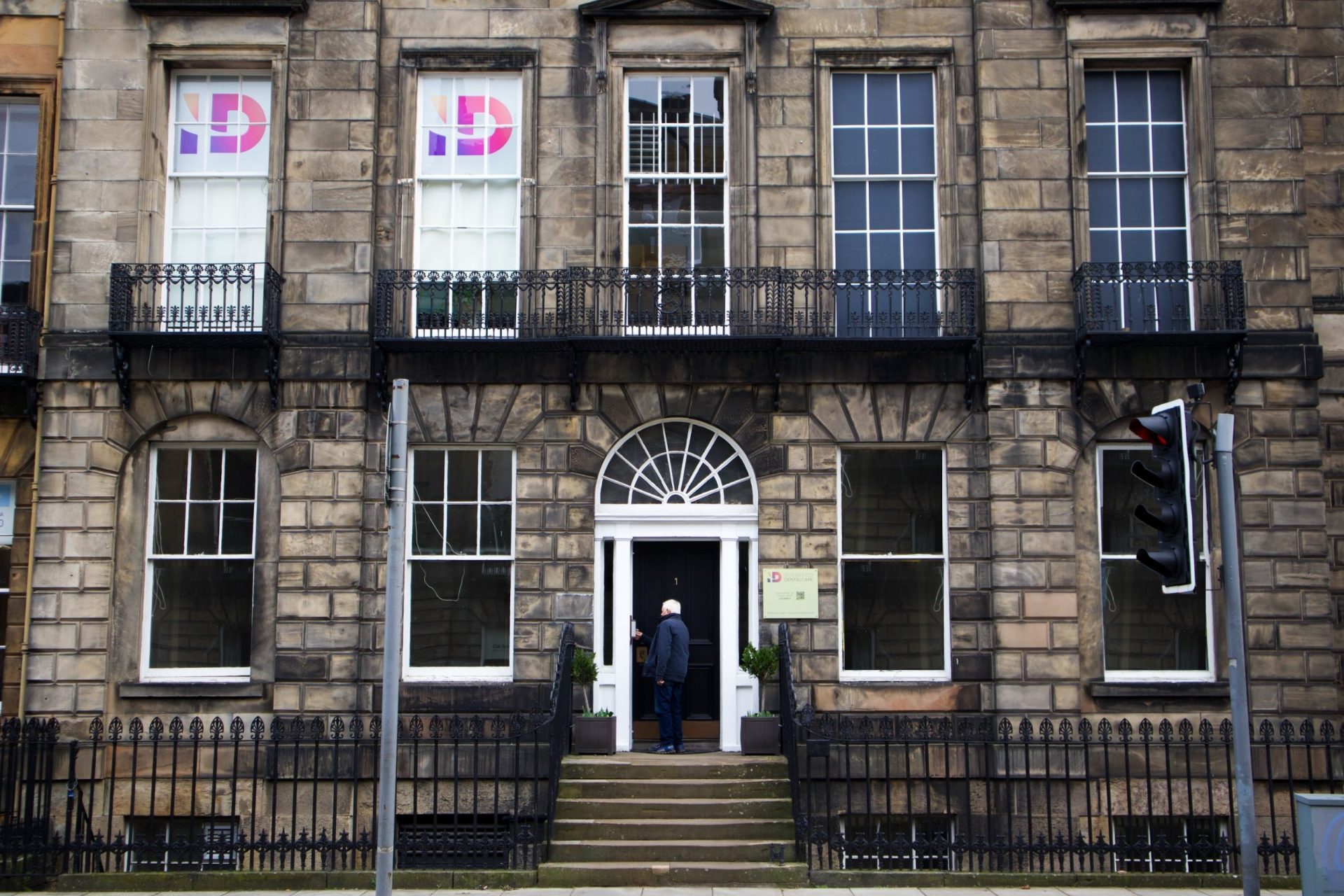
    Georgian entrance of Integrated Dentalcare on Manor Place, Edinburgh, with black front door and IDC logo in the upper windows

    You don’t need to travel to London or abroad. Our ceramic implant patients travel from across Scotland and the north of England, and we plan appointments to keep your trips to a minimum. Edinburgh has excellent transport links, and the practice is about seven minutes from a train station. Many patients stay overnight in Edinburgh, and we work closely with functional medicine practitioners very near the practice, so your visit can support your wider health too.

    If you live far away, you can start with a free video consultation on Microsoft Teams with Aimee, our implant coordinator and nurse, to ask your questions before deciding to make the journey.

    The first step at the practice is our Implant Consultation & Whole-Mouth Overview. It’s a 30-minute appointment focused on the teeth that need replacing and how the rest of your mouth affects them. It isn’t a replacement for a check-up with your own dentist, so it won’t go into detail on things like small cavities or cracks unless they’re obvious. We look at your mouth from an engineering perspective: why the problem happened in the first place, and what else might become an issue, so you can avoid it happening again. We’ll also talk through titanium and ceramic options and answer your questions without pressure. The £119 fee is credited against your implant placement if you book your planning appointment within two weeks.

    Call us on 0131 225 9093 or email [email protected] to book.

    About the author: Dr Neeraj Puri qualified from the University of Glasgow in 1996 and has over 20 years of focused experience in implant dentistry, from single teeth to full-arch restorations. He has placed zirconia implants since 2010 and is Clinical Director of Integrated Dentalcare and Inverleith Dentalcare in Edinburgh.
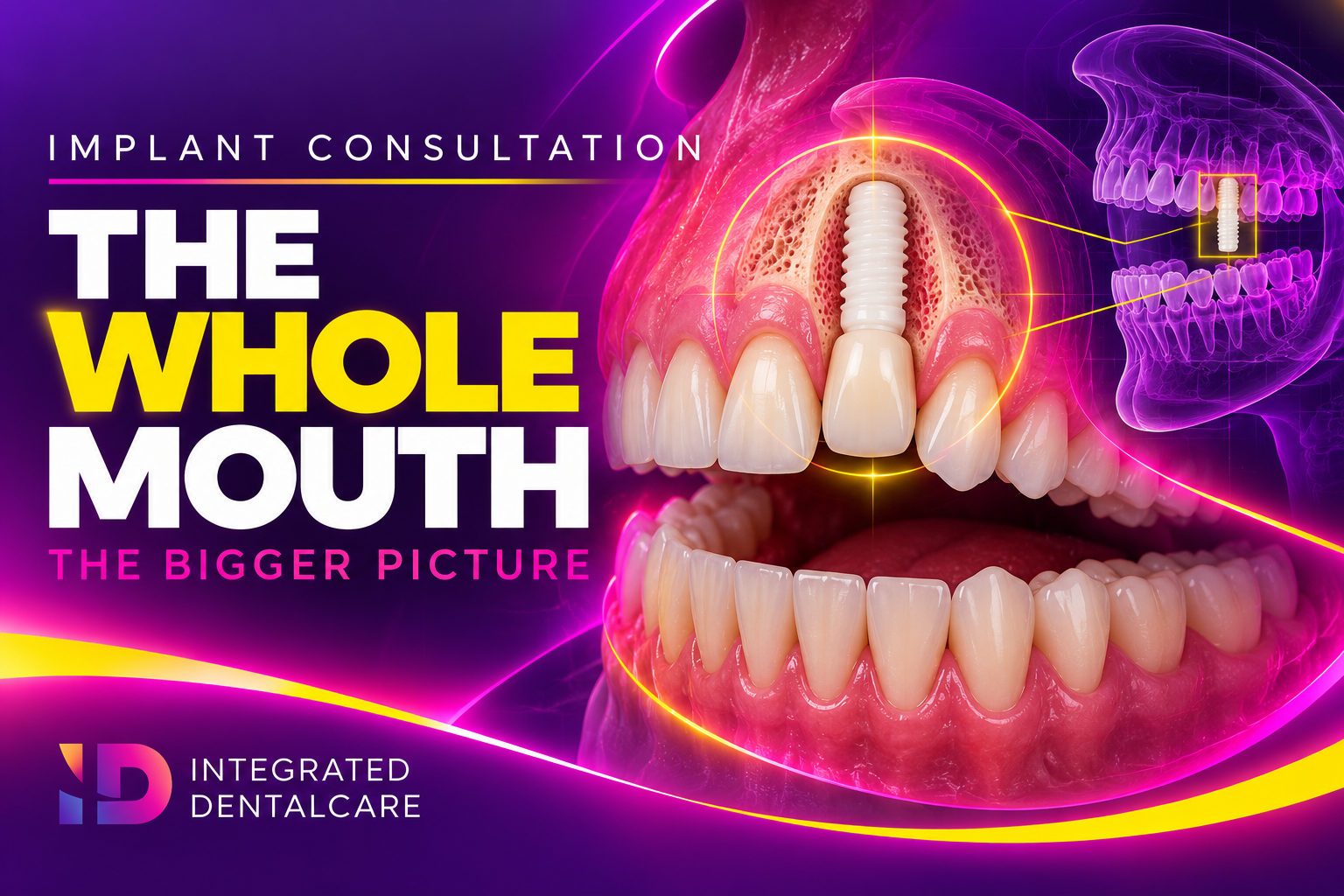
  • Implant Consultation & Whole-Mouth Overview

    Implant Consultation & Whole-Mouth Overview

    By Dr Neeraj Puri, BDS (Glasgow 1996) Integrated Dentalcare, Edinburgh Published October 2026 7-minute read

    Almost every patient who comes to me for a ceramic implant tells me a version of the same story. They knew what they wanted. They just couldn’t find anyone in Scotland who offered it.

    They come from the islands and the north of Scotland, from communities like Findhorn, and from Northumberland, Yorkshire, Huddersfield and even the south of England. Most found us through a Google search that finally landed, or, for some, through the IAOMT’s directory of biological dentists, where we were previously listed. Almost all say the same thing: “I wish I’d known about you sooner.”

    Why people go looking for a metal-free implant

    The patients I see are rarely looking for “an implant”. They’re looking for a dentist who thinks about the whole person, not just the gap.

    Many describe what they want as holistic or biological dentistry. They want to keep metals out of their body wherever possible. Some have had allergy testing, such as a MELISA test, which suggested a sensitivity to certain metals. Others have read about metal particles and byproducts and would rather not take that risk. Others are already working with a health practitioner and want their dental treatment to fit with that wider approach.

    Some patients have concerns about root-filled (“dead”) teeth and how they may affect their wider health, and choose to have them removed. When that tooth is replaced, they don’t want metal going into the jawbone in its place.

    Others worry about mixing metals. A conventional implant is rarely just titanium: the screw, the connecting part and the crown can each be a different alloy. Some patients are concerned that different metals bathed in saliva can create small electrical currents, a “battery effect”, and want to avoid that altogether.

    I don’t think anyone should have to justify that choice. My job is to explain the options honestly, so you can make the decision that sits right with you.

    What they want is someone with real experience who understands why this matters to them, not someone who dismisses it.

    Why it’s so hard to find

    There are two reasons.

    First, very few dentists in Scotland place ceramic implants. They need different planning, different surgical handling and different components from titanium. Many practices simply don’t offer them.

    Second, even where the treatment exists, it’s hard to find online. Search for ceramic or zirconia implants in Edinburgh and you’ll mostly see directories and London clinics. Our own website hasn’t said enough about it either. That’s changing, starting here.

    What we do at Integrated Dentalcare

    Dr Neeraj Puri reviewing a 3D digital implant plan on the X-Guide NXT navigation screen at Integrated Dentalcare, Edinburgh

    I’ve placed implants for around 20 years and have been placing zirconia implants since 2010. Implant dentistry is the focus of my clinical work. My main ceramic implant system is Swiss Dental Solutions (SDS), and I also use Straumann’s ceramic implant where it suits the case.

    Most of the ceramic implants I place are one-piece designs. The implant and the part that holds the crown are a single piece of zirconia, so there is no internal screw and no join between different materials.

    A few things patients tell me matter to them:

    • Metal-free from root to crown. A zirconia implant with a ceramic crown, with no metal in the mouth.
    • Clean components. The SDS ceramic implants carry the CleanImplant Foundation‘s Trusted Quality mark. To earn it, randomly sampled sterile-packed implants are examined under a scanning electron microscope in accredited laboratories, then peer reviewed. The Foundation has found contaminants on many implants straight out of the packet, so few systems qualify.
    • Metal-free from start to finish. The SDS concept uses only metal-free products during treatment, even the surgical drills are ceramic. That isn’t the case with every ceramic implant provider.
    • Keyhole, guided surgery. I plan with 3D scans and place implants using X-Guide navigation, often through a small opening rather than cutting back the gum. Navigation is included in the fee.
    • Natural healing support. We use PRF, made from your own blood, and laser therapy to support comfortable healing.
    • The whole mouth, not just the gap. As an experienced general dentist, I look at old fillings, root-filled teeth, gums and bite before planning the implant. Many of our patients also ask about safe amalgam removal.

    Fewer visits: tooth out and implant in, often the same day

    Many clinics remove a tooth, wait months for healing, then bring you back to place the implant. That means more procedures, more injections, more healing time and, if you live far away, more journeys.

    In most of our cases, I remove the tooth and place the implant in the same appointment:

    1. Planned in advance. I plan the implant digitally before you arrive, choosing the position where it will carry biting forces best.
    2. The site is cleaned with laser. Laser decontaminates the socket, and the light also supports the body’s own healing response.
    3. Your own healing factors. PRF, made from a small sample of your blood, is placed in the site to support natural healing.
    4. Guided placement. X-Guide navigation follows my plan to the exact coordinates through a small keyhole opening. Unlike a fixed surgical guide, it lets me adjust in real time if the bone is softer or shaped differently from what the scan showed, which is often only clear once the tooth is out.

    The result is one procedure instead of several, a single healing period, and your new tooth sooner. Some cases need other problems resolved first, and I’ll tell you at your consultation if that applies to you. Navigation is included in our fees, so you’re not paying extra for it.

    A real X-Guide navigated procedure at Integrated Dentalcare, in under a minute.
    See the whole process for yourself, from 3D scans and digital planning to guided placement.

    One patient’s experience

    Eilean Donan Castle near Skye in the Scottish Highlands, with snow-capped mountains and its stone bridge reflected in the loch

    A functional medicine practitioner travelled six hours from the very north of Scotland for a ceramic implant. She had spent a long time looking for someone in Scotland who could offer it.

    Afterwards, she told us she was so glad to have found us. The procedure was minimally invasive and comfortable, and her healing went smoothly. She particularly valued the natural approaches to healing, such as PRF and laser therapy, alongside the guided keyhole technique.

    Is a ceramic implant right for you?

    Not always, and I’ll tell you if it isn’t.

    Where ceramic implants shine is wherever each tooth can be replaced as an individual implant. That might be a single tooth, a short bridge across three teeth, or even six or seven teeth, as long as each can be restored on its own implant to look like a natural tooth emerging from the gum. Because the implant is white, there’s no grey metal showing through thin gum, and even if the gum recedes a little over the years, it won’t look unsightly. Research also suggests gum tissue tends to respond well to zirconia, with some studies finding less plaque build-up than around titanium (Shrivastava et al., 2024).

    Before and after: upper front tooth removed and replaced the same day with a Straumann ceramic implant, shown with the final crown four months later, Integrated Dentalcare, Edinburgh

    A front tooth removed and replaced with a ceramic implant in the same appointment, shown with the final crown four months later. Bonding on the neighbouring teeth was carried out by the patient’s own dentist.

    Where I’d usually recommend titanium:

    • Full-arch cases with a lot of bone loss. For a full mouth of fixed teeth where much of the bone has gone, these are often “end of the road” cases. Titanium systems give more flexibility, and the parts can be retrieved and adjusted if needed, which matters when you need the result to last for decades.
    • Heavy grinders and clenchers. Any implant can fracture under heavy forces, titanium included. The difference is retrievability: titanium systems are made of separate parts that can be adjusted or replaced, which gives more options if something goes wrong. If you grind heavily, especially under stress, titanium may be the safer choice.

    The exception is when only a few teeth are missing. Your remaining natural teeth help protect the implant, because they sense biting pressure and guide your bite. In those cases ceramic can still be an excellent option, even if you grind.

    The only way to know is a proper assessment. You can read more about the treatment on our zirconia dental implants page.

    If you’ve been searching too

    Georgian entrance of Integrated Dentalcare on Manor Place, Edinburgh, with black front door and IDC logo in the upper windows

    You don’t need to travel to London or abroad. Our ceramic implant patients travel from across Scotland and the north of England, and we plan appointments to keep your trips to a minimum. Edinburgh has excellent transport links, and the practice is about seven minutes from a train station. Many patients stay overnight in Edinburgh, and we work closely with functional medicine practitioners very near the practice, so your visit can support your wider health too.

    If you live far away, you can start with a free video consultation on Microsoft Teams with Aimee, our implant coordinator and nurse, to ask your questions before deciding to make the journey.

    The first step at the practice is our Implant Consultation & Whole-Mouth Overview. It’s a 30-minute appointment focused on the teeth that need replacing and how the rest of your mouth affects them. It isn’t a replacement for a check-up with your own dentist, so it won’t go into detail on things like small cavities or cracks unless they’re obvious. We look at your mouth from an engineering perspective: why the problem happened in the first place, and what else might become an issue, so you can avoid it happening again. We’ll also talk through titanium and ceramic options and answer your questions without pressure. The £119 fee is credited against your implant placement if you book your planning appointment within two weeks.

    Call us on 0131 225 9093 or email [email protected] to book.

    About the author: Dr Neeraj Puri qualified from the University of Glasgow in 1996 and has over 20 years of focused experience in implant dentistry, from single teeth to full-arch restorations. He has placed zirconia implants since 2010 and is Clinical Director of Integrated Dentalcare and Inverleith Dentalcare in Edinburgh.

  • Safe Amalgam Removal: What You Need to Know

    Safe Amalgam Removal: What You Need to Know

    If you’re thinking about replacing your old amalgam (silver) fillings with more modern, tooth-coloured alternatives, you’re not alone. Many patients today are choosing composite fillings — not just for aesthetic reasons, but also because they prefer materials that feel more biocompatible and natural.

    But when it comes to removing amalgam fillings, safety is essential. Amalgam contains mercury, and while it’s stable when intact, the removal process can release mercury vapour and fine particles if not handled correctly.

    At Integrated Dentalcare, we follow strict protocols to ensure that the removal of amalgam fillings is carried out as safely and gently as possible.

    Why Safe Amalgam Removal Matters

    Amalgam has been used for decades in dentistry and is generally considered safe when in place. However, when it’s disturbed or drilled out, mercury vapour can be released. Minimising your exposure during this process is crucial — and something we take very seriously.

    Our approach is based on internationally recognised techniques to protect both you and our team throughout every step of the procedure.

    Our Key Safety Protocols

    Here’s how we ensure a safer amalgam removal experience:

    🦷 Use of a Rubber Dam

    A rubber dam is a flexible, protective sheet that isolates the tooth or teeth being treated.

    ✓ It creates a sealed barrier to prevent any amalgam debris or mercury vapour from entering your mouth.

    ✓ It also helps you breathe more comfortably and safely throughout the procedure.

    🌀 High-Volume Suction

    We use hospital-grade high-volume suction systems to immediately capture any particles and aerosols released during the removal process.

    ✓ This equipment is positioned carefully to minimise airborne mercury exposure.

    ✓ It works continuously throughout the appointment, keeping the area as clean and safe as possible.

    💧 Continuous Water Cooling

    During removal, the tooth is gently cooled with a steady stream of water.

    ✓ This helps reduce heat from drilling, which can increase mercury vapour.

    ✓ It also lowers the amount of dust or particles in the air, making the environment safer for both patient and clinician.

    Replacing Amalgam With Modern Composites

    Once the amalgam is safely removed, we restore the tooth using tooth-coloured composite materials that are not only aesthetically pleasing, but also bond beautifully to your natural enamel. These materials are carefully selected for their durability, appearance, and compatibility with your oral health.

    A Gentle, Tailored Approach

    As always, our focus is on delivering dentistry gently, with your comfort and wellbeing in mind. If you have concerns about your existing amalgam fillings or are simply curious about the options available, we’re here to help guide you — with no pressure and full transparency.

    Thinking About Replacing Your Amalgam Fillings?

    Book a consultation with Dr. Vera Da Silva or Dr. Ching Feng Sia, our experienced clinicians. We’ll assess your current restorations, answer your questions, and help you decide if amalgam replacement is the right choice for you.